


Letter to 319 MPs voting for coerced vaccination of U.K. Care Home workers
Letter to all Members of Parliament
who voted for the amendment of the Health and Social Care Act (2008)
House of Commons
London
SW1A 0AA
Re: Health and Social Care Act 2008 (Regulated Activities) (Amendment) (Coronavirus) Regulations 2021. Division 53: held on Tuesday 13 July 2021.
I write in relation to the above debate on the amendments to the Health and Social Care Act 2008, which introduced compulsory vaccination for care home workers. According to Hansard records[1], you voted in favour of the amendments, which passed by 319 votes for to 246 votes against.
The debate posed the question of enforcement of a “complete course of doses of an authorised vaccine” for staff working in a care home; that staff should not be allowed to enter care home premises until they had provided evidence that they had been vaccinated against coronavirus with an authorised vaccine. In essence, this meant that in order to continue to work in the care home sector, carers must be vaccinated or risk losing their livelihoods.
The debate on 13th July 2021 focussed heavily on the failure of the Government to produce a promised Impact Assessment, which it had stated had been prepared and would be provided in time for the debate. This naturally prompted speculation that the Assessment contained inconvenient information which had therefore been suppressed. There was nevertheless strong evidence and argument brought forward that forcing care home workers to undergo a course of vaccination undermined their fundamental right to informed consent. More than this: “mandatory vaccination would be crossing the Rubicon on medical choice, medical confidentiality and bodily autonomy” (column 281, quoting a constituent). No adequate answers were given to these questions and yet the motion passed by an easy margin.
Furthermore, the following facts were known at the time of the debate;
- It was known in October 2020 that the vaccine trials specifically excluded studying the effects of the vaccine on transmission.
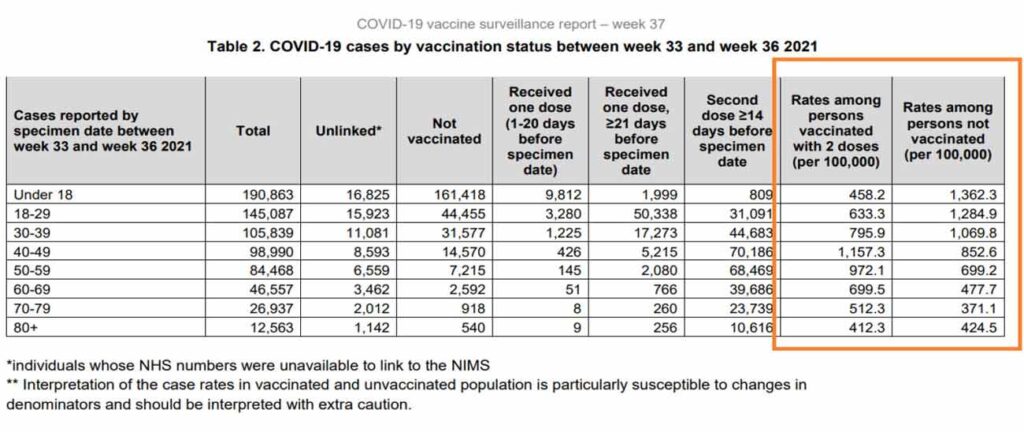
- By July 2021 there was real data showing that the incidence of COVID was relatively high in the vaccinated group compared to the unvaccinated, and it was therefore known that vaccination offered little reduction in the risk of infecting care home residents.
- The dangers of developing coronavirus vaccines were well known, including (inter alia) the risks of antibody-dependent enhancement.
- By 30th June 2021 more than 300,000 yellow card reports had been filed covering adverse events following vaccination against COVID. By this time 1,440 events with a fatal outcome had been registered in which the patient died shortly after vaccination.
- Care home workers’ rights to Informed Consent were effectively cancelled.
These are facts that are in the public domain, but we have to assume that members of parliament would have had access to non-public sources of information. It has subsequently (after 13th July 2021) become clear following various freedom of information requests, that many more safety red flags were included in non-public filings submitted by the vaccine manufacturers to various medical regulators around January 2021.
It is clear that the debate raised important issues and it would be useful to understand how these factors were considered in arriving at a decision to support this legislation, particularly in light of the requirement for holders of public office to make decisions “using the best evidence and without discrimination or bias”.
The principle of respecting bodily autonomy has been one of the foundations of western society. Breaching this principle represents a major disruption to the social contract. It must not be glossed over. In fact it is imperative that the ethical breach is acknowledged, and that this foundational ethical principle is reinforced and highlighted such that it cannot be breached again.
The following arguments represent why the decision was illogical as well as unethical. However, it is important to emphasise that the ethical breach would still stand even if the scientific arguments were not as clear cut.
We have set out below our sources for items 1 to 5 and look forward to hearing from you as to how you reached your decision to vote for this amendment.





Appendices
Item 1 – Transmission NOT studied during vaccine trials
The coronavirus vaccines were never tested for their effects on transmission during the short trials. This appears to have become more widely known since Pfizer Senior Executive Janine Small gave her now infamous ‘Speed of Science’ testimony to the EU Parliament in October 2022. However, this was known and written about in The British Medical Journal by their Associate Editor, Peter Doshi in October of 2020. In his article which was widely read, Doshi wrote:
“None of the trials currently under way are designed to detect a reduction in any serious outcome such as hospital admissions, use of intensive care, or deaths. Nor are the vaccines being studied to determine whether they can interrupt transmission of the virus.”
Item 2 – Real world data showing that vaccinated were catching COVID
By July 2021 statistics[2] released by PHE were showing that vaccines were far from being effective at stopping transmission and were achieving levels of less than 50% effectiveness against transmission, where 50% Is generally considered a floor to performance.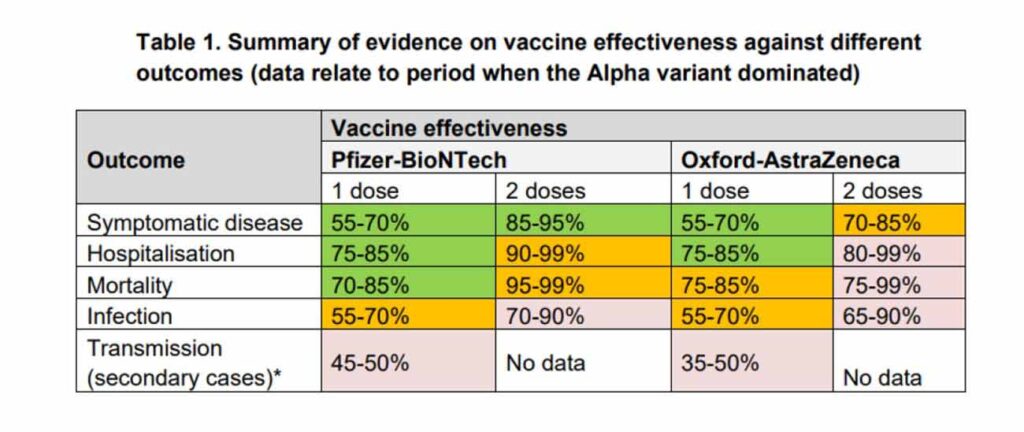
Item 3 – Dangers of previous coronavirus vaccine development programmes.
The history of coronavirus vaccine development shows that vaccine candidates are often withdrawn due to the incidence of adverse reactions, including but not limited to Antibody Dependent Enhancement (ADE). An article from 2018 provides an overview of coronavirus vaccine trials which resulted in negative results due to Viral-Induced Enhanced Disease (ADE)[4]. This context should have been relevant to any debate on coercing care home workers into taking a newly developed vaccine. With regards to these specific vaccines, many high profile scientists expressed concerns over the association with the covid-19 vaccines and blood clots, specifically UK Medical Freedom Alliance wrote in November 2020 to the MHRA and the Secretary of State outlining numerous concerns[5]. Doctors For Covid Ethics also expressed concerns (subsequently validated) to European Medicines Agency (EMA) in February of 2021[6].Item 4 – Actual adverse reactions were over 300,000 at the time of the vote
MHRA’s list of side effects included both minor side effects and serious conditions, including inflammation of the heart muscle (myocarditis) or inflammation of the lining outside the heart (pericarditis). By 30th June 2021, the MHRA managed yellow card system was reporting [7] around 300,000 adverse reactions (summarised below);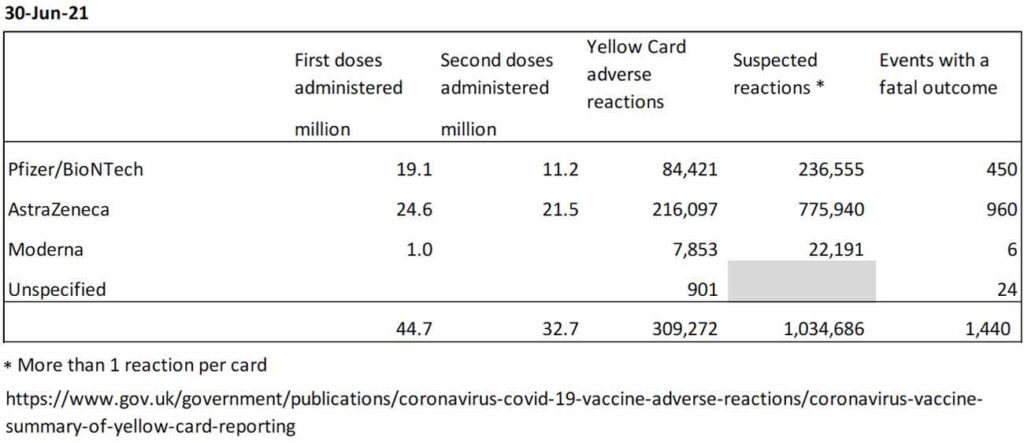
Item 5 – The right to informed consent
The right to informed consent is a fundamental right for any individual[10], whereby any decision to consent to a treatment “must not be influenced by pressure”. This is particularly relevant in the case of coronavirus vaccines as the authorised vaccines were only authorised on a temporary authorisation basis after a very short trial.References
- https://hansard.parliament.uk/commons/2021-07-13/debates/BD25E3D7-6EFB-48A9-A564-966D3898D8FC/NationalHealthService
- https://assets.publishing.service.gov.uk/government/uploads/system/uploads/attachment_data/file/1000512/Vaccine_surveillance_report_-_week_27.pdf
- https://assets.publishing.service.gov.uk/government/uploads/system/uploads/attachment_data/file/1018416/Vaccine_surveillance_report_-_week_37_v2.pdf
- https://www.frontiersin.org/articles/10.3389/fmicb.2018.02991/full
- https://www.ukmedfreedom.org/open-letters/ukmfa-open-letter-to-mhra-jcvi-and-matt-hancock-re-safety-and-ethical-concerns-of-proposed-covid-19-vaccine-authorisation-and-rollout
- https://doctors4covidethics.org/urgent-open-letter-from-doctors-and-scientists-to-the-european-medicines-agency-regarding-covid-19-vaccine-safety-concerns/
- http://web.archive.org/web/20210711170632/https://www.gov.uk/government/publications/coronavirus-covid-19-vaccine-adverse-reactions/coronavirus-vaccine-summary-of-yellow-card-reporting
- https://wherearethenumbers.substack.com/p/why-is-the-mhra-hiding-critical-safety
- https://www.gov.uk/drug-safety-update/yellow-card-please-help-to-reverse-the-decline-in-reporting-of-suspected-adverse-drug-reactions
- https://www.nhs.uk/conditions/consent-to-treatment/


